Chapter Four: Simple Compositions
4.3 Horizontal Composition
Similar to vertical composition, horizontal framing is often determined by the subject’s form. When conveying expansive scenes—particularly those involving lakes, oceans, or coastal vistas—horizontal composition becomes a natural and evocative choice. It imparts a sense of balance, stability, and quiet harmony to the viewer’s gaze.
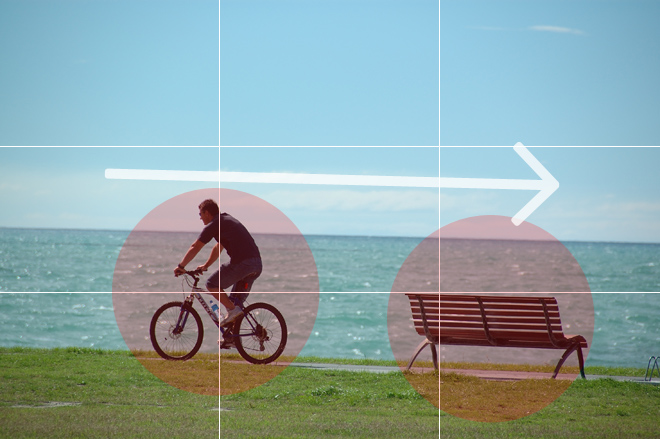
◄ Captured on the seaside promenade in Napier, this image shows a father and daughter cycling past. I photographed them individually, as well as in sequence—one behind the other—and particularly favor this frame for its quiet narrative of daily life. Yet, in the moment of capture, I failed to align the horizon properly; as a result, the sea line appears slightly askew. This minor deviation may be corrected in post-processing through digital alignment techniques.Nikon D70 & AF-S VR Zoom-Nikkor 18-200mm f/3.5-5.6 G ED DX
Be Mindful of the Horizon Line
When employing horizontal composition, the most critical consideration is ensuring that the horizon line remains level. A steady horizontal or vertical axis contributes to visual harmony and coherence in the frame. While not an absolute rule, maintaining a stable horizon prevents jarring visual tension and guides the viewer’s eye with quiet confidence. Unless artistic intent demands otherwise, I strive to preserve this principle.
During horizon correction, I seek out strong structural elements within the frame—such as architectural edges or natural lines—that serve as reliable reference points. When distortion occurs, or when depth layers resist perfect alignment, I focus on preserving the dominant structure’s integrity rather than demanding perfection in every line.
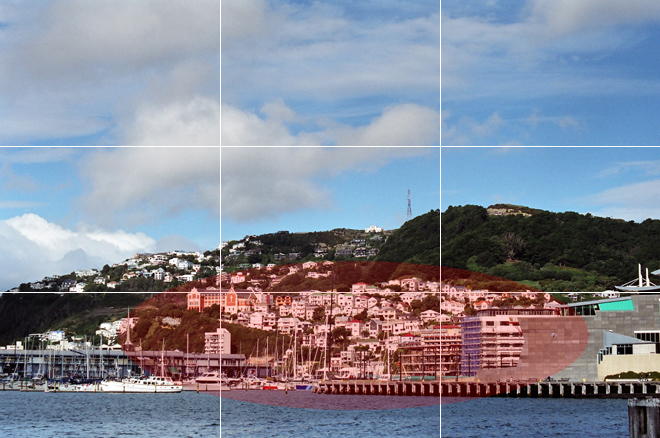
► Compared to the nocturnal stillness of the bay captured last evening, Wellington by day pulses with energy. Save for rainy days, the sky remains a perpetual stage of azure and drifting clouds. Scenes such as bays are ideally rendered in horizontal format—indeed, most often they should be. Though the junction of bay and structure may not always align perfectly with the horizon, or even follow a straight line—especially when the coastline curves—the frame must not appear tilted. A subtle imbalance can disrupt visual equilibrium, so care in alignment remains essential.Nikon F75 & Nikkor 24mm F2.8D & Fujifilm XTRA 400
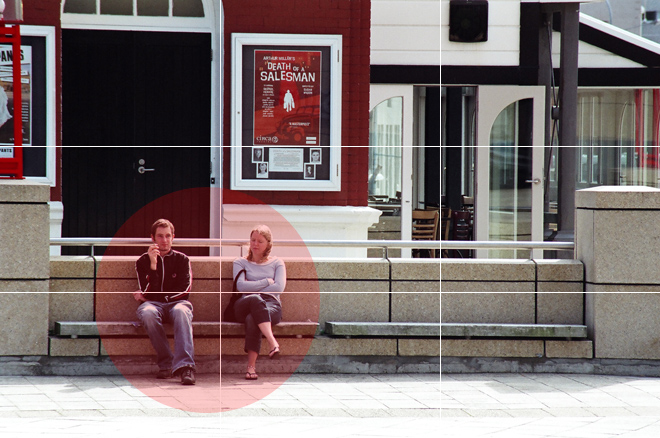
◄ At the seaside theater in Wellington, I observed a couple resting on benches along the promenade. The scene carried quiet narrative potential, so I used a telephoto lens to capture that fleeting moment. Here again, horizontal composition is employed—but with an intentional application of the rule of thirds. The figures occupy the lower third vertically and are positioned within the left third horizontally. For alignment, I used the railing behind the seats as my reference point; though the distant buildings did not perfectly align with it, I accepted this minor inconsistency. The key was ensuring my chosen reference remained true to the frame’s intent.Nikon F75 & Nikkor 70-300mm f/4-5.6G & Fujifilm Fujicolor Superia X-TRA 400