Chapter Four: Simple Compositions
4.4 Symmetrical Composition
Symmetry is a visual principle we encounter frequently in daily life. Consider the human face: our eyes and ears are naturally arranged in symmetry, and if we draw a vertical line down the center from the nose, both sides of the face appear balanced and harmonious. Similarly, most architectural designs favor symmetry in their outward forms.
When employing symmetrical composition, one must be particularly cautious of monotony and rigidity. A viewer’s attention is drawn to elements within the frame; if those elements are purely symmetrical yet lack contrast, tension, or narrative depth, visual fatigue quickly sets in—diminishing engagement and emotional resonance.
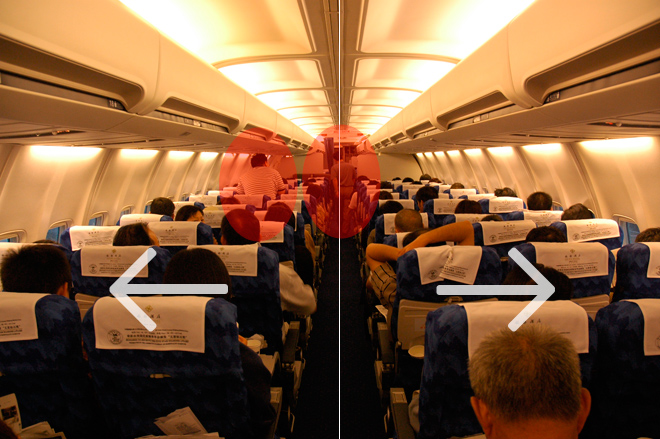
◄ Just before departure for Urumqi, heavy thunderstorms over Guangzhou Baiyun Airport forced all passengers to wait aboard the aircraft for an hour. Domestic flights in mainland China are typically smaller, and I was seated in the rear third of a cabin served by only two flight attendants. I chose to stand precisely at the center, composing the scene using a balanced, symmetrical arrangement. Shooting from the central axis carries inherent risk—too often resulting in lifeless imagery. Yet, from my vantage point forward, a radiating spatial structure emerged: the overhead cabin framework and play of light above contrasted with the rows of seated passengers below. Two travelers moving ahead introduced subtle asymmetry, breaking perfect symmetry just enough to capture the moment I sought. Nikon D70 & AF-S 18-70mm Nikkor f/3.5–4.5G ED
1. Imperfect Symmetry
To avoid mere repetition, I employ subtle techniques that preserve symmetry while introducing variation. The method is simple: incorporate elements outside the symmetrical structure to create intentional imbalance—what I call *asymmetry within symmetry*. This delicate tension adds narrative depth and visual intrigue.
2. Emphasis on Spatial Extension
An alternative approach lies in ensuring the symmetrical structure itself possesses strong spatial extension. By arranging elements from near to far, viewers first perceive the symmetry, then follow the visual journey through depth—inviting movement and contemplation across the frame.
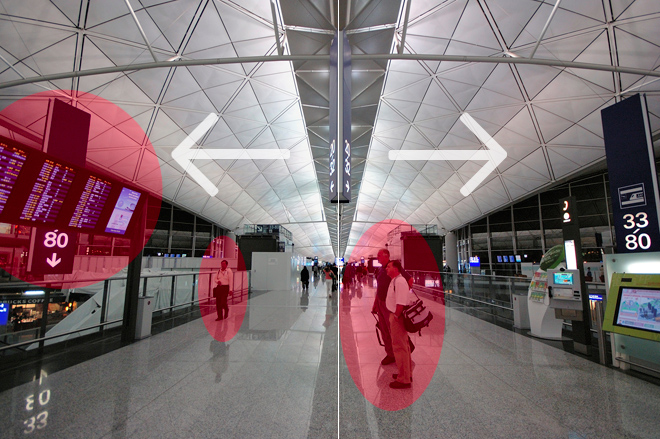
► At Hong Kong International Airport’s corridor, I again used symmetrical composition. A passenger gazes at the departure board on the left; behind him, the corridor and surrounding space unfold in perfect symmetry—except for his figure. I often place an asymmetrical foreground within a symmetrical frame to inject contrast and vitality, preventing visual stagnation. Nikon D70 & Sigma 10–20mm F4–5.6 EX DC HSM
3. Mediated Symmetry
Another powerful technique involves using a third-party medium to generate perceived symmetry—such as reflections in glass, mirrors, or water. These indirect sources create what I term *mediated symmetry*, where the illusion of balance emerges through external surfaces.
By applying these three refined strategies, symmetrical composition avoids mechanical rigidity. The interplay of contrast and structure deepens visual interest, embedding within the image a quiet narrative—subtle at first glance, yet rich with meaning upon reflection.
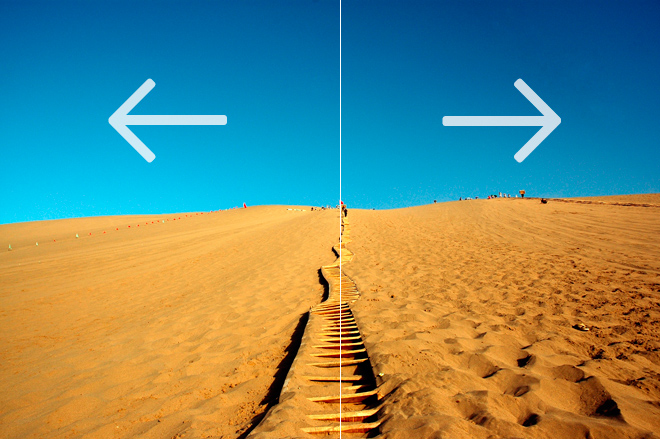
◄ Before descending the dunes of Mingsha Mountain, one must climb to the starting point. Though distant views suggest a gentle slope, standing on the sand reveals an incline approaching sixty degrees. To assist climbers, wooden grid platforms were laid across the dune—appearing like steps from afar. Yet they are merely open frames, making each step a struggle as feet sink deep into the shifting sand. Only then does one truly grasp both the terror and grandeur of the desert. I ascended carrying a heavy camera bag, each step deliberate—afraid to slip and tumble uncontrollably down the dune’s face. The path, though less treacherous than the legendary Shu Road, still evokes the ancient line: “Harder than ascending to the heavens.” Every step required care, for a misstep could send me tumbling into ruin—along with my gear. I paused every five minutes to catch breath and observe shifting light and form. From above, the angle revealed a striking composition: the wooden grid divides the frame into two balanced halves; sky above and dunes below mirror each other in natural symmetry. Though structured as symmetrical composition, the scene is not perfectly balanced—inviting viewers’ eyes to wander and compare, fostering a dynamic engagement with the image. Nikon D70 & AF-S 18-70mm Nikkor f/3.5–4.5G ED