Chapter Three Mastering the Three Fundamental Elements of Photography
3.3 Control of Light and Shadow
3.3.1 Expression of Light and Shadow
At the essence of photography lies the art of capturing light and shadow. Thus, mastering how to observe, interpret, and record these elements becomes a central pursuit in photographic practice. To effectively manage the interplay of light and shadow within one’s frame, it is essential first to understand the nature of various light sources—since shadows are intrinsically shaped by their character. Below, we explore several photographic techniques commonly employed to express theme through light and shadow.
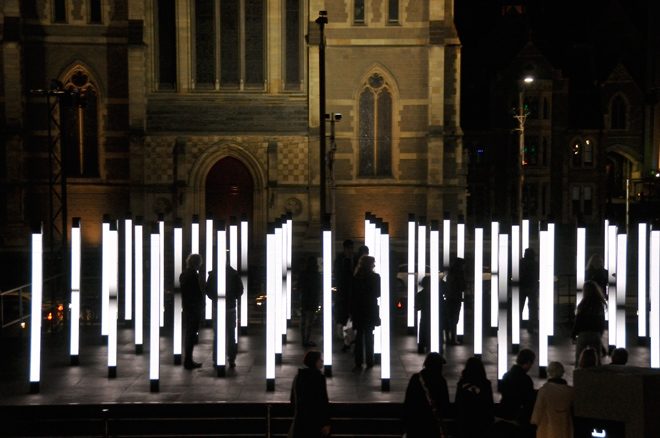
◄ Federation Square lies directly opposite Flinders Street Station and St Paul’s Cathedral in Melbourne. Upon first arriving, I was immediately captivated by its bold architectural presence. Originally met with local skepticism—some deemed it too jarring for the city’s aesthetic—it has since evolved into one of Melbourne's most iconic landmarks. Though I was unable to explore the interior this time, the complex houses institutions such as the National Gallery of Victoria (Ippert Collection), the Australian Film Institute, the Concert Hall and Theatre (BMW Edge), along with several restaurants. I hope to return in the future, ideally during summer.
During my visit, Federation Square hosted "The Light in Winter," an installation that drew me to the luminous ceiling fixtures and a striking LED column array near St Paul’s Cathedral. By day, the effect was already compelling; by night, dynamic light projections danced across the plaza as visitors gathered to photograph and reflect. The contrast between these modern illuminations and the solemn lines of the ancient cathedral created a scene of profound beauty. I composed this image with simplicity in mind, capturing that fleeting harmony.
Nikon D300 & AF-S VR Zoom-Nikkor 18-200mm f/3.5-5.6 G ED DXFront Lighting
Front lighting is among the most frequently employed techniques in photography. It occurs when the direction of light aligns with the camera’s vantage point—meaning the subject faces the source. Under such conditions, subjects are uniformly illuminated, making exposure and focusing notably easier. Colors appear natural, tones remain soft, and overall image quality is balanced. For these reasons, front lighting offers one of the most accessible approaches for photographers seeking consistency and clarity.

► Passing through Timaru at midday, we paused for lunch at May’s Bakery—a modest café serving light fare and coffee. For a honeymoon journey, the meal felt sparse, yet its ambiance was rich with charm: simple décor, vintage photographs adorning the walls, and a quiet artistic grace. Lydia sat by the window facing the street. The weather was clear; sunlight streamed through, creating a natural glow across her face from my vantage point. By combining ambient outdoor light with the café’s soft interior illumination, I achieved a remarkably natural skin tone. Front lighting remains one of photography's most intuitive and reliable directions.
Nikon D300 & AF-S VR Zoom-Nikkor 18-200mm f/3.5-5.6 G ED DXSide Lighting
In contrast to front lighting, side lighting occurs when the camera’s angle forms a diagonal or perpendicular relationship with the light source—typically at 45° or 90°. This creates pronounced contrasts between illuminated and shadowed areas, enhancing the subject’s three-dimensionality. The result is a clear distinction between the light side and dark side, where tonal gradation adds depth and visual interest. In essence, side lighting transforms a flat subject into one with sculptural presence.
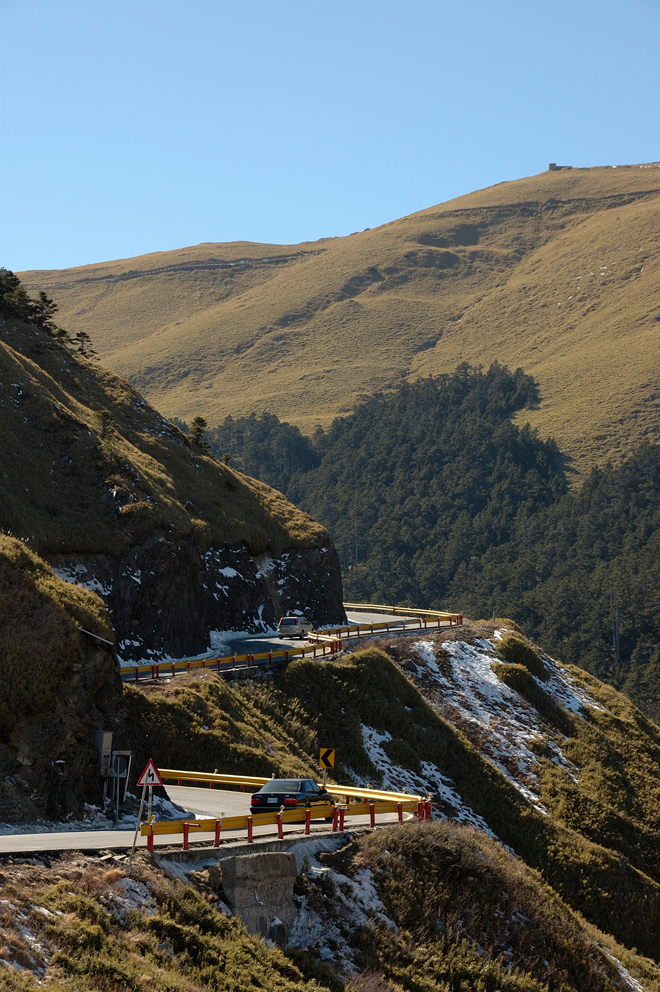
◄ While ascending Mount Hohu, we passed several rest points. The cold mountain air prompted frequent stops for warmth and restroom breaks. At the Hohu Pavilion, situated at 3,180 meters—second only to Wu Ling’s 3,272 meters and higher than Kunyang at 3,070 meters—we paused to admire the panoramic view. The pavilion offers accommodations and is especially enchanting during winter, when snow blankets the landscape.
On our way toward Wu Ling, the winding mountain road offered dramatic vistas. From a viewing platform before the pavilion, I noticed how the serpentine path layered across distant ridges. As a vehicle approached, I captured this image—part of a series of four taken in succession. The moment two cars aligned perfectly within the sunlit stretch, I chose this frame. Using a telephoto lens compressed spatial depth, yet the relative size difference between the two vehicles emphasized perspective and distance. This interplay of compression and contrast felt both intentional and poetic.
Nikon D70 & AF-S VR Zoom-Nikkor 18-200mm f/3.5-5.6 G ED DXBacklighting
Backlighting stands in direct opposition to front lighting: here, the camera faces the light source directly, with the subject positioned between the lens and illumination. This creates a luminous halo around the subject’s silhouette, known as contour lighting. When facing the light source directly, three distinct backlit modes may emerge: direct backlighting, side-backlighting, and top-backlighting. The differences lie solely in the angle between camera and light source.
In direct backlighting, only faint rim-light appears along the subject’s edges; the rest remains in shadow. Side-backlighting introduces more reflective detail, enhancing contrast and sculptural effect—ideal for emphasizing form. Top-backlighting demands attention to avoid large, distracting shadows cast by the subject itself—especially when silhouetting a figure against an open sky.
► The journey from Wanaka to Franz Josef Glacier was not long, though the mountainous terrain made travel demanding. We arrived at Franz Josef Glacier Country Retreat early in the afternoon—just after five o’clock. After check-in, we were assigned a spacious room for two nights, offering ample rest despite the packed itinerary. The local tourism office was closed by the time I arrived to book excursions, and only later did I learn that guided glacier walks had filled up three days prior. My preparations were clearly insufficient.
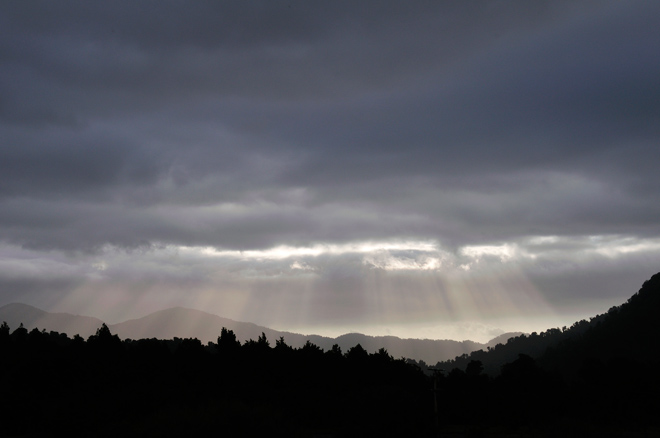
That evening, I had reserved dinner at the hotel’s restaurant. With few dining options in town—around five or six establishments—I decided to begin with the hotel’s own offering. Returning from a stroll through town, twilight still lingered as I wandered briefly outside the building. The mist had parted slightly, revealing shafts of sunlight piercing through cloud gaps.
From this vantage, distant trees and mountain ridges were bathed in backlighting. Above, the clouds glowed with ethereal "Christ’s Light"—a phenomenon where sunlight streams through atmospheric gaps, creating divine beams. The composition layers foreground forest and mountains in silhouette, translucent light rays passing through cloud strata, and a dense canopy of clouds above. This stacked arrangement not only conveys depth but enriches the image with narrative texture and emotional resonance.
Nikon D300 & AF-S VR Zoom-Nikkor 18-200mm f/3.5-5.6 G ED DXSilhouette
A silhouette is achieved by exploiting backlighting through deliberate exposure control. By underexposing the subject while maintaining normal exposure in the background, the outline becomes sharply defined—rendering the form as a dark shape against a bright field. This technique emphasizes contrast, isolates subject from context, and generates powerful visual drama.
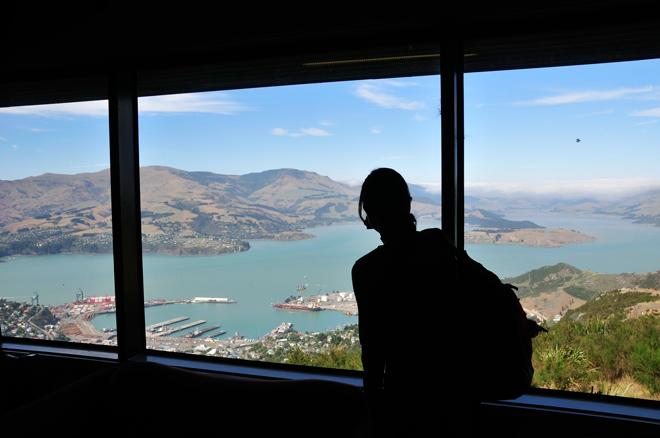
◄ At dusk near the Longteng Bridge in San Yi, our group descended to a stream for a refreshing dip. The sky glowed with soft pink hues as pedestrians strolled across the bridge above. I framed this shot using silhouette technique—capturing a fleeting moment of human presence against the fading light. Silhouettes thrive in high-contrast scenes, and when paired with minimal composition, they evoke a cinematic quality, rich with narrative potential.
Nikon D300 & AF-S VR Zoom-Nikkor 18-200mm f/3.5-5.6 G ED DXLight Compression (Exposure Control)
Light compression—also known as "exposure control"—involves intentionally reducing background exposure while preserving proper illumination on the subject, often through flash or fill lighting. Unlike silhouetting (where background is exposed normally and the subject underexposed), light compression ensures the subject remains properly lit while the background is darkened. This technique proves especially effective in backlit conditions, allowing both foreground and background to remain visible and distinct.
When using flash to illuminate a subject against an unlit background, the result is a sharp foreground with a completely black backdrop—another manifestation of light compression. This method excels at isolating the subject and eliminating distracting elements.
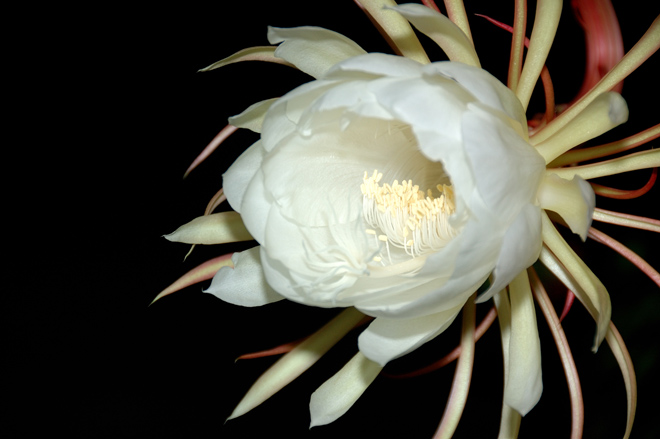
► The idiom "a bloom that lasts but a night" long fascinated me—yet until now, I had never seen the night-blooming cereus. To my surprise, one grows in our garden. The flower opens only at night and closes again by dawn. I chose a quiet evening to photograph it.
The plant grows beneath a lamppost and power pole, creating an uneven background. By using flash to underexpose the surroundings while ensuring proper exposure on the bloom, I achieved a technique known as light compression. Though ambient light was sufficient, I used flash to intensify the flower’s form and diminish background clutter. The result is a focused, intimate portrait—where the subject emerges clearly against an obscured world.
Nikon D300 & AF-S VR Zoom-Nikkor 18-200mm f/3.5-5.6 G ED DXFlare (Lens Flare)
Lens flare occurs when shooting directly toward or near a light source—common in backlighting and side-lighting scenarios. It arises from internal reflections within the lens’s optical elements, producing scattered light patterns or ghostly halos. Modern lenses employ anti-reflective coatings to minimize such artifacts, yet flare remains unavoidable under strong light. When used artistically, lens flares can lend a dreamlike quality or narrative atmosphere to an image.
To prevent unwanted flare, photographers should avoid direct alignment with bright sources and use a lens hood to block stray light. Yet when embraced, flare becomes not a flaw but an expressive element—adding mood and poetry to the frame.
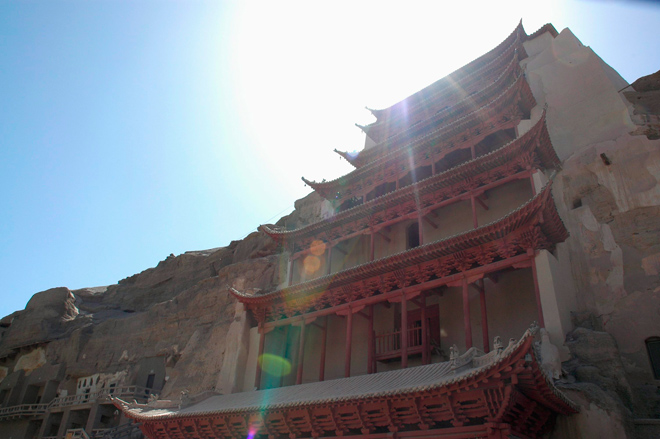
◄ Dunhuang Mogao Caves lie nestled in the cliffs of Mingsha Mountain, southeast of Dunhuang City in Gansu Province. Alongside the Yungang and Longmen Caves, it ranks among China’s “Three Great Grottoes.” First carved in 366 CE, the complex expanded over centuries until the Yuan Dynasty. Today, approximately 735 caves remain.
Before entering, all bags must be stored outside. Photography is strictly prohibited within the exhibition zones—though visitors may photograph from beyond the fence. I circled the perimeter four times, searching for a compelling angle. One vantage point offered a side view of the pagoda.
Regrettably, my visit coincided with a Dunhuang Studies symposium the following day—hence the props visible below. The nine-story pagoda, standing 33 meters tall, houses Cave No. 96—an immense statue of Maitreya Buddha, measuring 35.6 meters in height and constructed from stone core with clay and pigment finish.
As the sun rose directly overhead, a brilliant shaft of light swept across the pagoda’s front. The resulting lens flare illuminated the structure with a radiant, almost sacred glow—creating an image of breathtaking grandeur.
Nikon D70 & AF-S 18-70mm Nikkor f/3.5-4.5G EDHigh Key Lighting
High key lighting creates a luminous, airy aesthetic—characterized by bright tones, soft contrast, and an overall sense of clarity and purity. In natural light conditions, this effect is achieved by adjusting exposure settings and shooting angles to elevate the subject’s brightness. The result is a delicate, ethereal image—often associated with Japanese-style photography.

► On weekends, we often take our child outdoors for a change of pace. Occasionally, she joins us at a café to enjoy coffee and unwind in the afternoon.
On this occasion, Zoe had been active in the morning. By afternoon, she was exhausted and fell asleep on a sofa chair. I set my aperture to f/4, used spot metering, and increased exposure compensation by +2/3 EV—aiming for a high key effect. Though the subject was brightened, detail remained intact without overexposure. Her skin appears smooth and delicate—capturing a moment of tender fragility.
Fujifilm FinePix X100Low Key Lighting
In contrast to high key, low key lighting emphasizes darkness. It preserves detail in shadowed areas while selectively illuminating only a few zones—creating mood, drama, and depth. While high key evokes serenity and purity, low key conveys mystery, intimacy, and emotional weight. Both styles imbue images with narrative power.
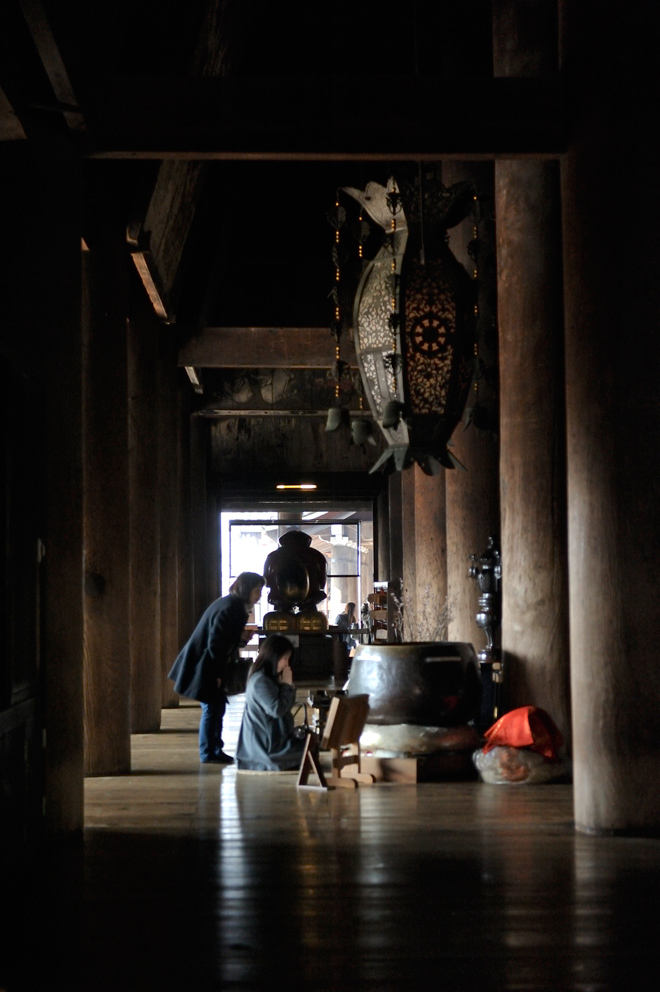
◄ This was my third visit to Kiyomizu-dera in Kyoto—a place I’ve long cherished. Each journey yields a photograph I hold dear.
The contrast between the bright exterior plaza and dim interior of the main hall created a challenge. I sought to capture worshippers engaged in prayer, but wanted to avoid disturbing others. After scanning the space, I found a vantage point on the right side—offering an unobstructed view of the main gate and a kneeling mother and daughter.
As the crowd thinned, only this pair remained. The daughter was deeply absorbed in prayer. I used a telephoto lens and spot metering to carefully balance exposure—preserving shadow detail while preventing highlights from blowing out. This deliberate retention of dark areas defines the low key style, creating an atmosphere rich in quiet reverence and narrative depth.
Nikon D700 & AF-S NIKKOR 24-70mm f/2.8G ED