Chapter Three Mastering the Three Fundamental Elements of Photography
3.2.3 The Essence of the Image
The Six Principles
The composition and application of visual elements constitute the manifestation of form. Yet what we refer to as the "essence" of an image lies in whether this manifestation evokes resonance within the viewer, stirring emotion and sentiment. To enable the observer to perceive not merely a scene but the photographer’s inner state or intended atmosphere at that moment, mastery of visual essence becomes essential.
During the Southern and Northern Dynasties, Xie He of the Southern Qi dynasty articulated the "Six Principles" in his treatise *Records of the Classification of Ancient Paintings*. These six precepts—vital energy and rhythm, bone method in brushwork, representation of subject matter through form, appropriate coloring according to type, composition and placement, transmission and copying—served as standards for evaluating Chinese painting. My own approach to conveying meaning and emotion in photography draws deeply from these very principles.
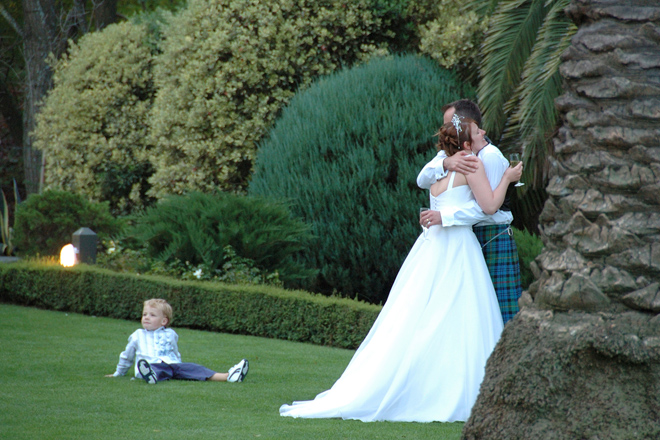
◄ This photograph was taken at Mission Winery. Originally, I had planned to dine
there, but an unexpected Scottish wedding had reserved every table. Though dining was not possible, I
wandered through the estate and happened upon a quiet moment: the bride and groom embracing in a
secluded corner of the garden, juxtaposed against an innocent child playing nearby. I captured this
fleeting gesture instantly. True love and romance often unfold not in grand gestures, but quietly, in
unassuming corners.
In the preface of Zoe’s book *Free, Yet Lonely*, I once read: “Some say to know
whether someone is worth knowing, watch them alone. If even in solitude they carry a presence of
charm—someone who dares to face themselves, speaks honestly with their inner self—they are undoubtedly a
person of depth and intrigue.”
Photographing such intimate, unguarded moments—whether a couple
embracing away from the crowd or an individual in quiet contemplation—allows us to capture emotions most
authentic, often overlooked amidst the noise of everyday life.Nikon D70 &
AF-S VR Zoom-Nikkor 18-200mm f/3.5-5.6 G ED DX
Vital Energy and Rhythm (Qi Yun Sheng Dong)
By "vital energy and rhythm," I refer to capturing the essence of a subject—the soul behind its form. When photographing people, I seek gestures that reveal character and individuality. Such moments often demand familiarity with the subject to perceive subtle nuances. For landscapes, my focus lies in rendering light and shadow so vividly that the viewer feels present, as if stepping into the scene itself—an effect achieved through deliberate composition.

► Puffing Billy, a beloved destination for family outings, lies approximately 56
kilometers from Melbourne’s city center—about an hour's drive. The most distinctive feature of the
Puffing Billy train is not only its scenic route through a lush forest, but also the freedom it offers
passengers: you may hang from the windows rather than sit rigidly in your seat. Children, in particular,
delight in this whimsical journey.
Wide-aperture lenses are a photographer’s dream—though their cost
often proves a barrier. While I appreciate large apertures, my choice depends on the subject and
narrative intent. I own three prime lenses with wide apertures: 24mm, 50mm, and 105mm. I typically open
the aperture not only for available light but also to isolate and emphasize a specific subject. During
my ride, the train jolted through curves; seated mid-train, I found ideal vantage points to photograph
distant carriages.
Noticing children’s fascination with the journey, and their delight in watching
passengers hanging from windows, I used my 105mm lens to capture one child gazing intently at the
passing scenery. A very wide aperture creates shallow depth of field, ideal for highlighting facial
expression. To include more environmental context while preserving focus on the face, I would close down
by two stops—ensuring background details remain sharp. For me, aperture is not a fetish but a tool—an
instrument of creative choice, not an obsession.Nikon D70 & AF-S VR
Micro-Nikkor 105mm f/2.8G IF-ED
Bone Method in Brushwork (Gu Fa Yong Bi)
In traditional painting, "bone method in brushwork" refers to the deliberate use of line and stroke to define form. In photography, I interpret this as mastery over depth of field and focus—determining what remains sharp, what blurs into abstraction, and how the interplay between clarity and softness shapes a subject’s presence and overall impact.
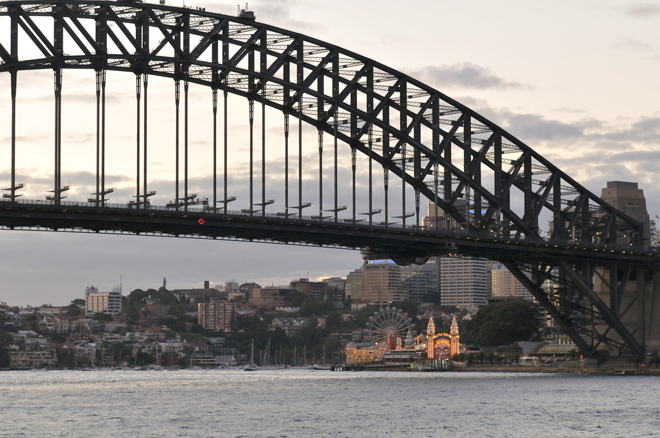
◄ Sydney Harbour Bridge is most famously known for its annual New Year’s Eve
fireworks display. This steel-arched structure, an iconic landmark, inspires awe whether viewed from
afar by ferry or approached on foot across its span. Its grandeur becomes most apparent up close—its
scale, engineering precision, and architectural power resonate deeply.
During my stay in Sydney, the
bridge and Opera House offered endless photographic possibilities. Different vantage points, times of
day, weather conditions—all transformed the experience into something entirely new. My approach to
composition mirrors that of learning calligraphy: we begin with basic strokes, progress through
imitation, and eventually develop a personal style. The core lies in patience and an innate sense of
beauty. Similarly, mastering composition is a gradual journey—through repetition, reflection, and
refinement, one’s photographic voice emerges.
In this image, I employed partial framing to convey
intention. By showing two-thirds of the bridge’s arch against the amusement park below, I created a
striking contrast in scale and perspective—proof that impact need not come from full-frame vistas.
Sometimes, a fragment of the scene speaks more powerfully than the whole.
Color-wise, I used subdued,
cool tones to evoke a monochromatic mood. The amusement park, naturally illuminated by varied light
sources, bursts with vibrant hues—its liveliness contrasting sharply with the surrounding gray and cold
tones. This interplay deepens emotional resonance.Nikon D300 & AF-S NIKKOR
24-70mm f/2.8G ED
Representation of Subject Matter Through Form (Ying Wu Xiang Xing), Appropriate Coloring According to Type (Sui Lei Fu Cai)
“Representation of subject matter through form” and “appropriate coloring according to type”—I focus on the
selective editing of visual elements, as well as the strategic use of light, shadow, and tone. In
psychology, Gestalt theory posits four foundational principles: similarity, proximity, continuity, and
common fate. Simply put, the human mind naturally organizes fragmented visual input into coherent
wholes.
Thus, in composition, a partial form may suggest the whole. A single gesture or fragment of a
scene can trigger perception and emotional recognition in the viewer. Moreover, shifts in tone—whether
black-and-white or high dynamic range (HDR)—can dramatically alter the emotional weight of an image.
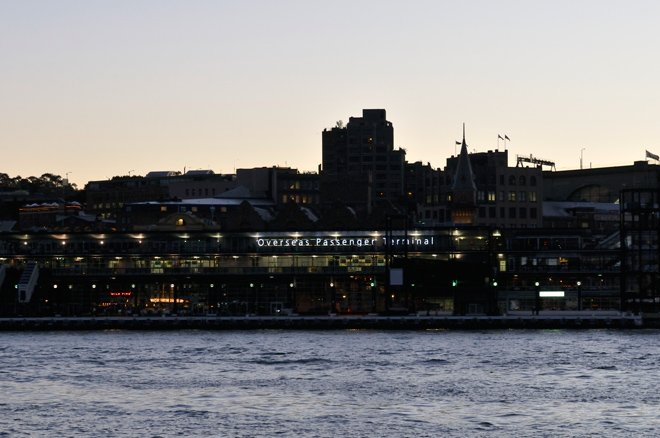
► Around Sydney lies a network of harbors, among them the famed Sydney
Cove—renowned for its proximity to both the Opera House and Harbour Bridge. To the left of Circular Quay
lies the Overseas Passenger Terminal, a gateway for international cruise ships such as the *Queen
Elizabeth II*.
During my visit, no large cruise ship was docked. Instead, the area brimmed with
elegant dining establishments—among them *Wildfire*, a perennial favorite in travel guides. These
restaurants share one defining trait: expansive floor-to-ceiling glass walls offering panoramic views of
the Opera House. I had planned to dine at *Wildfire*, but arrived too early—the kitchen was still
closed, and hunger compelled us to seek another venue nearby: *Waterfront*.
Most digital single-lens
reflex cameras shoot in a 3:2 aspect ratio, though many modern sensors favor 4:3. Some cameras even
offer specialized ratios such as 16:9 or square (1:1). Each ratio alters the visual rhythm and narrative
emphasis. After careful consideration of subject, composition, and emotional tone, I chose to preserve
the original colors and frame the image in 3:2. The cool-toned lighting, combined with extreme
highlights and shadows on the tone curve, naturally evokes a black-and-white aesthetic. I preferred to
keep the original color palette intact—its authenticity best reflects the scene as it truly was.Nikon D300 & AF-S NIKKOR 24-70mm f/2.8G ED

◄ The Kawarau Bridge in Queenstown is said to be the birthplace of bungee
jumping. Gazing down into the river gorge, one feels a primal tremble in the legs—though I lacked the
courage to leap. Still, watching others jump, and feeling that shared thrill of fear and exhilaration,
was profoundly moving.
In this frame, a couple stands at the jump platform, about to participate in
the "you jump, I jump" ritual. Before donning their harnesses, they embrace—offering silent courage to
one another. I captured this moment spontaneously.
Nonverbal cues—body language, spatial
positioning—often convey more than words. When viewers recognize such gestures from their own
experience, they project personal emotion into the scene. Whether through empathy or self-reflection,
such images create deep and lasting resonance.Nikon D300 & AF-S VR
Zoom-Nikkor 18-200mm f/3.5-5.6 G ED DX
Composition and Placement (Jing Ying Wei Zhi), Transmission and Imitation (Chuan Yi Mo Xie)
“Composition and placement” and “transmission and imitation” refer to the fusion of visual structure with emotional intent. Meaning is not conveyed merely through subject matter, but through thoughtful arrangement—through the placement of elements and the subtlety of gesture. Thus, throughout my photographic process, I draw upon these six principles to guide composition and editorial decisions—balancing form, tone, light, and emotion in service of a singular vision.