Chapter Three Mastering the Three Fundamental Elements of Photography
3.2 The Aesthetic of Composition
3.2.1 Concept of Composition
In his treatise *Yi Gai: Wen Gai* from the Qing Dynasty, scholar Liu Xizai wrote: "The four characters—beginning, development, turning point, and conclusion—are not merely structural devices. The beginning also contains the essence of the ending; the conclusion likewise incorporates the seed of the beginning. In between, both development and turning point must serve to unify and enrich the entire structure." At roughly the same time, Jin Shengtan in *Reading Methods for The Western Chamber* remarked: "It is precisely through these elements of beginning, development, turning point, and conclusion that the theme emerges clearly within the text."
Beginning, development, turning point, and conclusion—these four terms represent a traditional narrative structure in Chinese literature. In essence, they reflect both the method of storytelling and the arrangement of content. Yet today, this rigid framework has come to symbolize a mechanical and inflexible approach, often used pejoratively.
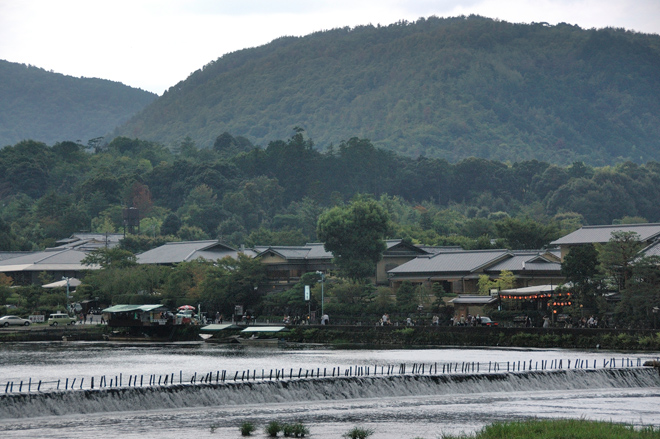
◄ This image captures my overall impression of Arashiyama. I walked from the distant footpath to the Tōgetsukyō Bridge, absorbing the essence of the landscape before capturing this moment. While Arashiyama’s shopping district evokes warmth and vibrancy, here the scene unfolds like a sumi-e ink painting—layered with depth and quiet contemplation.
Recently, reading Li Dahang’s *One Mountain Passed, Another to Come*, I found profound resonance. Though the book recounts Ang Lee’s cinematic journey, it constantly reminded me of photography. I believe that what photography conveys extends far beyond technique and light—it embodies the photographer’s observation, life experience, emotion, and inner world. Indeed, many non-photographic elements—culture, introspection, personal history—are intrinsically linked to the art. That is why two photographers standing in the same place may produce entirely different works. I have long held that to grow as a photographer, one must not only study continuously but also open the heart to diverse cultures and enrich life itself. This scene holds multiple implicit layers: the separation between mountain and water creates eight distinct planes of depth, while the tonal balance remains faithful to the actual ambient light. The contrast is high—matrix metering risks underexposure due to reflections from sky and water. Most critically, the narrow footpath might be overlooked if not carefully framed. I deliberately concealed my intended subject, inviting viewers to discover the subtle details hidden within nature’s folds.Nikon D70 & AF-S VR Zoom-Nikkor 18-200mm f/3.5-5.6 G ED DX
Principles of Composition
Photographic composition, much like narrative structure in literature, draws from the traditions of Western painting. The concept was first systematically applied during the Renaissance by Leonardo da Vinci. In Western art, composition often emphasizes points, lines, planes, and perspective. By contrast, Chinese painting places greater emphasis on expressive intention and holistic spatial arrangement.
Painting Is the Mind’s Seal
The Tang Dynasty poet Wang Wei mastered the fusion of poetry and painting. Su Shi, upon reading Wang’s five-character quatrain—“White stones rise from Lantian, red leaves thin on Yuchuan. No rain upon the mountain path, yet green mist wets one’s clothes”—exclaimed: “To read Wang Mojie’s poetry is to see painting within it; to view his paintings is to hear poetry.” Wang Wei was not only a celebrated poet but also an accomplished master of figure and landscape painting, later hailed as the founding ancestor of the Southern School of Chinese painting. His philosophy lies in using brushwork to express inner vision—images may appear chaotic, yet *painting is the mind’s seal*, a pinnacle of Chinese landscape art.
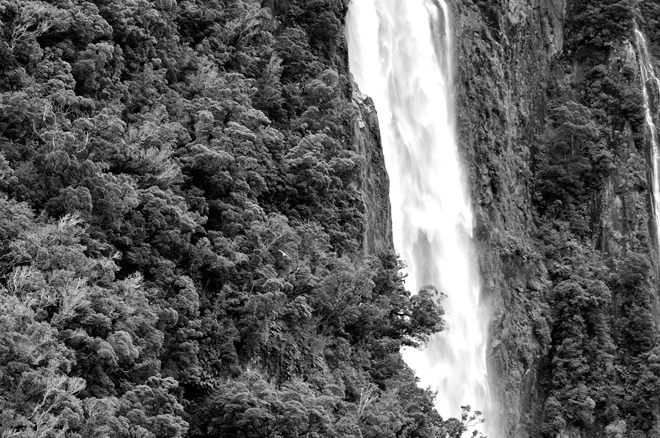
► Milford Sound offers guided fjord tours through two companies: Discovery Milford Sound and Real Journeys. Our rental vacation package included a ticket for Discovery’s service. Pricing varies throughout the day, so it's wise to consult their website schedule prior to departure—though lower-priced slots may coincide with tour groups.
Heavy rain had fallen the night before our visit, creating spontaneous waterfalls across the fjord. The cruise itinerary now included close encounters with these cascades—boats would approach them, playfully dousing guests on the upper deck. I captured this image just before the vessel drew near to a waterfall, drawn by its profound natural atmosphere. Before *Avatar*’s release, such a scene defied description; now it evokes the mythical world of Pandora.Nikon D300 & AF-S VR Zoom-Nikkor 18-200mm f/3.5-5.6 G ED DX
Composition as the Foundation of Photography
My understanding of composition blends Eastern and Western artistic traditions with insights from literary structure. Composition is a foundational framework, yet rigid adherence to it risks becoming the very obstacle it was meant to overcome—just as "beginning, development, turning point, conclusion" can become a trap if not transcended.
Yet I have always believed that mastering composition in photography resembles learning calligraphy. Calligraphic training begins with copying master scripts—emulating the brushstrokes of great masters before gradually developing one’s own style. Thus, composition is akin to the "regular script" of calligraphy: a disciplined foundation upon which personal expression grows.
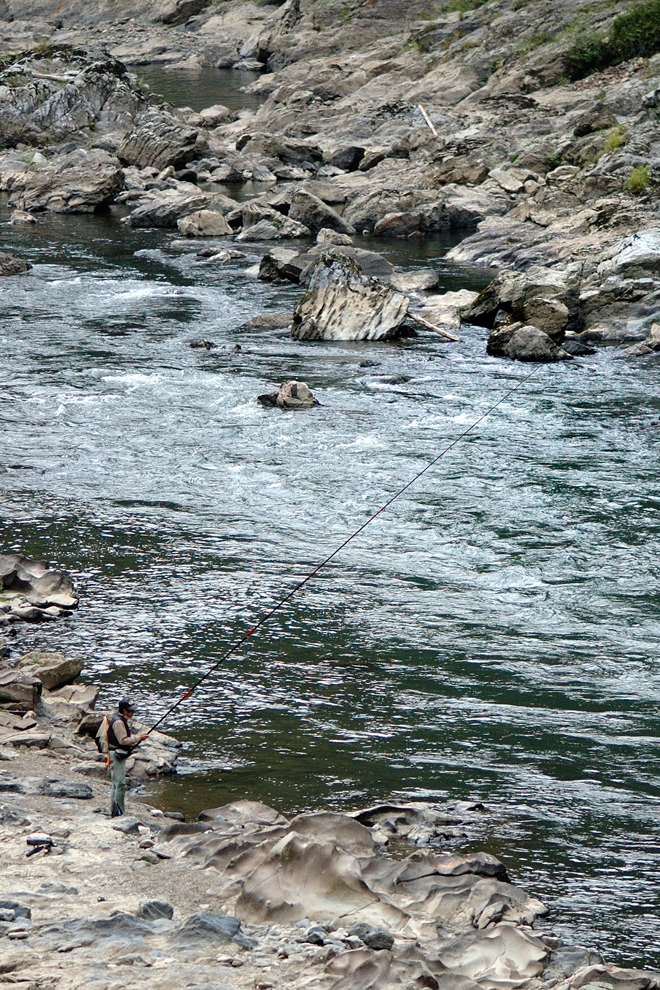
◄ While riding the Arashiyama sightseeing train, it paused briefly over the Katsura River. I photographed this scene from inside the moving car. When I noticed a fisherman by the riverbank, an unexpected emotion stirred—difficult to name but reminiscent of poems by Liu Zongyuan and Wang Shizhen, whose quiet solitude echoes across centuries.
River Snow — Liu Zongyuan
All birds have vanished from a thousand mountains.
No trace of man remains on ten thousand paths.
A lone boat, a straw cloak and hat—
An old man fishes in the cold snow.
Autumn River Solitary Fishing — Wang Shizhen
One straw hat, one cloak, one small boat.
One inch of line, one hook.
One song, one cup of wine.
One man alone fishes the autumn river.
Using a prime lens proved ideal here—no need to adjust focal length, only swift composition. The train’s brief stop demanded immediate framing after spotting a compelling subject. I pressed the shutter as the car began to move, carefully positioning the fishing rod to form a horizontal division across one-third of the frame. I particularly love this image: whether it’s the one-third foreground or two-thirds background, both evoke poetic stillness. Years of memorizing classical poetry have only deepened when lived through time and place—now, I truly converse with the ancients.Nikon D70 & AF-S VR Micro-Nikkor 105mm f/2.8G IF-ED
Expressing Inner Intention
Thus, to express one’s inner vision through photography, one must first master foundational composition principles—then expand outward into a unique personal style. Beyond technical theory, I believe photography faithfully reflects each individual’s inner or outer world—regardless of whether composition was consciously considered.
Yet through deliberate composition, one trains the eye and mind to tell stories visually—cultivating a personal language that authentically conveys what we wish to share. This is the world I hope readers will glimpse through my lens. Detailed discussion of compositional forms and patterns follows in the next chapter.
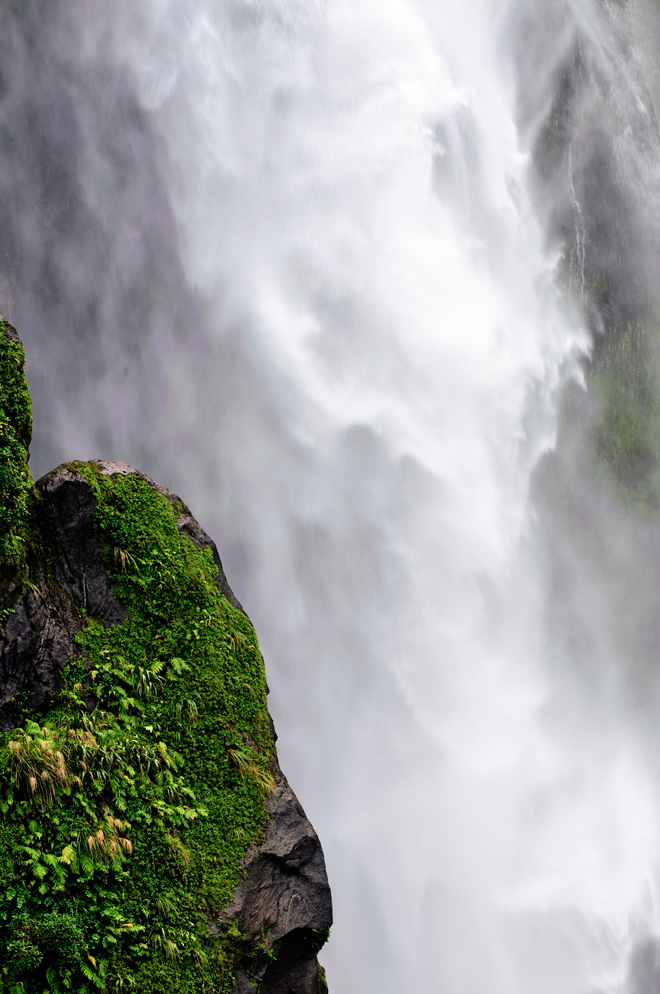
► Upon first arriving at Milford Sound, I felt a slight disappointment—nothing wrong with the place itself, but my expectations had been shaped by photographs so breathtaking they bordered on fantasy. The real scene differed from my imagination, leaving me momentarily adrift in melancholy. Yet now, reviewing the images, I see no gap between dream and reality.
After a night of rain, spontaneous waterfalls now cascade along both fjord banks. Misty veils and soft light enhance the grandeur and mystery of the landscape. I traveled aboard the Milford Sound Red Boat Cruises, where the captain deliberately steered close to the falls for optimal viewing. I photographed multiple cascades using two lenses: my standard 18–200mm and this image’s 105mm. Instantly, I envisioned sumi-e ink wash landscapes—where *spirit and rhythm* take precedence over literal form. As the Ming Dynasty scholar Wang Shizhen wrote: "In figure painting, form comes first; spirit transcends it. In landscape, spirit and rhythm are paramount—form resides within them." Though a principle of painting, it resonates deeply in photography. My own approach echoes the Yuan master Ni Yunlin: "What I call painting is but a casual brushstroke, not striving for likeness—merely to amuse myself." In this image, I composed three planes: mossy foreground, the waterfall’s mist-laden center, and a distant fragment of rock in the background. I used slow shutter speed not to blur motion but to capture a single, suspended moment.Nikon D300 & AF-S VR Micro-Nikkor 105mm f/2.8G IF-ED
3.2.2 Elements of Composition
As previously discussed, composition is a systematic and aesthetic method of arranging elements in space—considering placement, distance, scale, light and shadow, color, motion, and more. During the creative process, I habitually begin by analyzing how elements are segmented, combined, and applied to form a visual structure.
For any photographic theme, we can quickly distinguish between scenery (background) and objects (foreground). As space is divided spatially, we may identify foreground, midground, and background elements. Beyond tangible forms, light, reflection, and shadow also function as distinct compositional components.
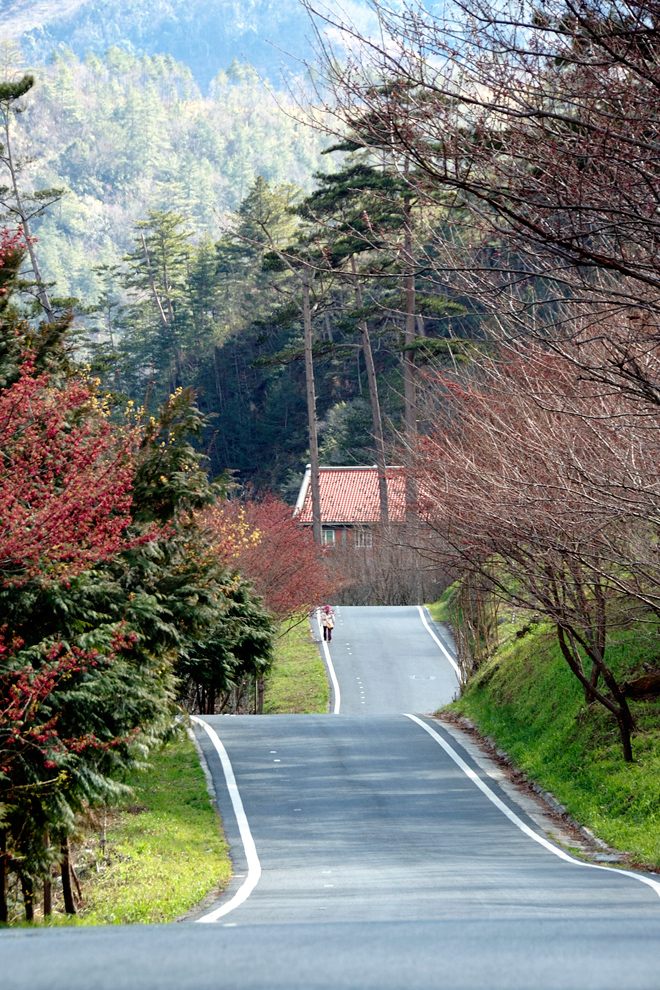
◄ This path lies between tea fields and a fish-viewing platform in Wuling Farm, during the season of blooming plum and cherry blossoms. An on-site volunteer mentioned that last week’s frost had damaged many flowers. At first, I puzzled over why the blossoms looked so unattractive—now I understand: frost damage.
This was my favorite stretch after scouting the terrain. The undulating path fascinated me—its rolling contour evoked a ribbon stacked in folds. The next day, I returned specifically to this spot and used a telephoto lens to compress the scene into one unified form. The choice of focal length proved intriguing: my eye naturally focused on overlapping ridges, but the lens required me to frame deliberately—excluding distractions and preserving only what I wished others to see.
The lone figure in the frame was carefully positioned. Initially, she stood behind me; I waited until she reached the far end of the path before capturing this image. The wait lasted nearly ten minutes—yet her presence deepened my emotional connection to the place.
Nikon D70 & AF-S VR Zoom-Nikkor 18-200mm f/3.5–5.6 G ED DX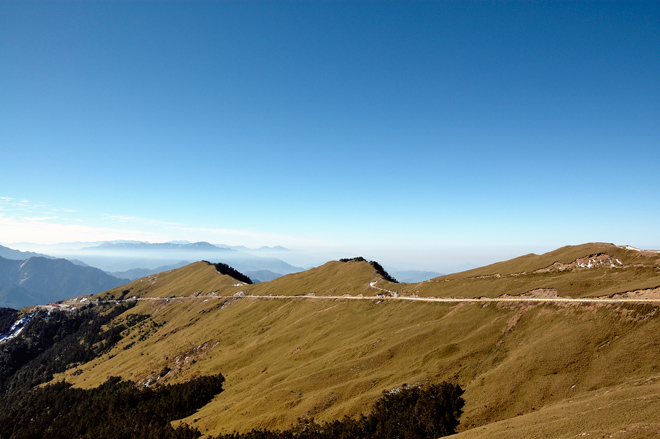
► On our way to Wuling, we passed through the Hehuan Mountains. Originally concerned about snow due to a cold front, we were relieved when temperatures warmed just before departure—no travel disruptions. It had been four years since my last visit to this place; returning felt like reuniting with an old friend. I stopped deliberately, capturing several images.
The weather was perfect—sky a brilliant, clear blue. I hadn’t brought my 10–20mm wide-angle lens this time, so I used only the 18–200mm and a 24mm lens. I set aperture to f/11, framing only three small hills on the left. These hills formed the primary subject; beneath them, a winding road carved out a secondary element. The distant misty mountains served as the first background layer, while the vivid blue sky formed a second. By layering these elements, I achieved both depth and visual richness.
Nikon D70 & AF-S VR Zoom-Nikkor 18-200mm f/3.5–5.6 G ED DXMastering the Interplay of Elements
During shooting, by thoughtfully combining these elements—selecting a subject, choosing supporting forms and background—and carefully managing focus point and depth of field, one can render not only what is seen but also the emotional resonance of a moment. Thus, manipulating compositional elements remains my most consistent and powerful approach to visual storytelling.