Chapter Three: Mastering the Three Fundamental Elements of Photography
Clarity of Focus, Beauty of Composition, Control of Light and Shadow
I have divided the mastery of foundational photography into three essential elements: sharpness of focus, aesthetic composition, and control over light and shadow. In this chapter, I share with you some practical techniques I employ, along with my pre-shooting contemplative process, to achieve mastery over these core principles.
3.1 Sharpness of Focus
3.1.1 Selection of the Focal Point
Subjects: People and Landscapes
In determining the focal point, I broadly categorize photographic subjects into two types: people and landscapes. Furthermore, wildlife photography may be provisionally grouped under the broader category of "people," as both involve capturing living essence.
People: The Essence of Presence
When photographing people or living beings, the most critical factor in focus selection lies in intention. For subjects with discernible form, I center my focus on facial features—particularly the eyes—as they carry emotional depth and vitality. Yet, more precisely, one must seek to capture not merely the physical form, but the very spirit of the subject.

◄ During our wedding session, I brought along the NATURA Black F1.9—a simple point-and-shoot camera—to capture candid moments during makeup and attire adjustments. In such portraits, I consistently focus on the eyes. When the gaze is alive, the subject’s presence becomes palpable; their inner character and temperament emerge with authenticity.NATURA Black F1.9 & Fujifilm Fujicolor Superia X-TRA 400
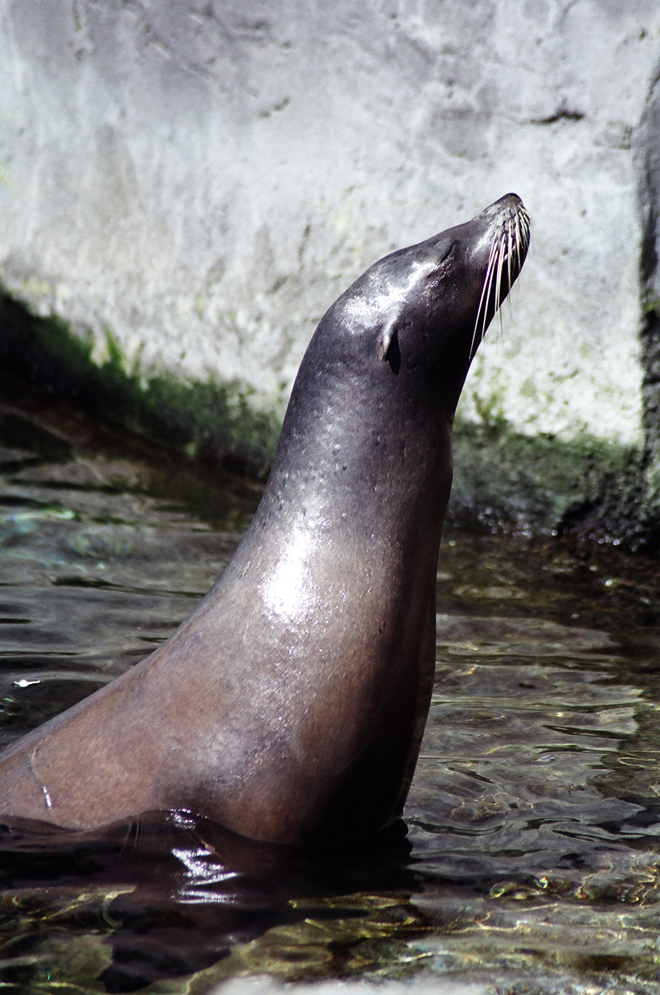
► At Auckland Zoo, I captured numerous images of animals. For wildlife
photography, I typically employ a telephoto lens. This photograph was taken at 300mm. As with human
subjects, I prioritize the eyes as my focal point—a choice rooted in how viewers naturally perceive and
connect with form.
From Han Feizi’s *Xue Zhi Shuo Zuoshang* (The Left Volume of the External Storehouse):
> “A guest once painted for King Qi. The king asked, ‘Which is hardest to paint?’
> The painter replied: ‘Dogs and horses.’
> ‘And which is easiest?’
> ‘Phantoms. For dogs and horses are known to all; they appear daily before the eye, so their likeness
is difficult to capture. Phantoms have no form; they are unseen, thus easier to depict.’
This parable reveals a profound truth: the more familiar an object, the harder it is to render with
authenticity—because viewers recognize its essence. The less familiar, the more freely one may
interpret. In photography, abstract subjects allow creative freedom; yet for known forms, precision in
focus and composition becomes essential. Thus, I select focal points that immediately draw the viewer’s
attention—elements instantly recognizable and emotionally resonant.Nikon F75
& Nikkor 70-300mm f/4-5.6G & Fujifilm Fujicolor Superia X-TRA 400
Guiding the Viewer’s Gaze
When viewers engage with a photograph, their attention naturally gravitates toward the sharpest area—unless the subject is abstract. Beyond this initial fixation, their gaze begins to wander and explore. I often use the focal point as a deliberate guide, directing attention through compositional elements to evoke mood and spirit—a method I frequently employ.
Contemplating the Subject
If the subject is not centered on facial features, or if abstraction and softness are desired, one must first clarify: what am I seeking to express? I habitually reflect before shooting—defining my theme and intended visual language. Only then do I determine the optimal focal point, aligning technique with intention.
Landscapes
When photographing landscapes, the process begins with contemplation. As I observe the scene, I examine every visual element—then deliberate which to include and which to omit. This is composition in motion: once the narrative of the image becomes clear, only then does focal point selection follow.
Human and Landscape in Harmony
When the subject merges people with landscape, I consider whether to let the person reveal the scene (to “lead” the viewer into the environment), or to use the landscape as a backdrop to elevate the human presence. These two approaches yield fundamentally different decisions in focus placement.

◄ After our daughter Zoe’s birth, our social circle evolved into one centered on
children. We began attending various playgroups. On a Sunday, we joined the Science Museum’s weekend
Playgroup event—some twenty to thirty families gathered on a grassy field, children laughing and
tumbling in joyful chaos. The scene was breathtaking. Unfamiliar elders even approached with long
lenses, quietly capturing the fleeting charm of these young lives.
Zoe is lively at home but shy in crowds—perhaps a trait inherited from me, who often claims to be
introverted and awkward with people. Yet few believe it.
I have long found children a challenging subject—especially at Zoe’s age. My photographic principle is
to avoid disrupting natural behavior; truthfully, I lack confidence in capturing spontaneous movement.
But I cherish the quiet moments: a fleeting glance, an unguarded gesture, a subtle emotion. Many
composition guides advise simplifying the background—especially when focusing on children’s interaction.
I follow this rule whenever possible. Yet, when context is unavoidable, I shift toward storytelling.
In this photograph, the foreground and subject are Zoe’s interaction with Eason. The background features
Eason’s parents, similarly engaged—holding cameras to photograph their own child. These quiet details
are powerful narrative elements. By skillfully combining focus and depth of field, I create a scene rich
with story—inviting viewers to interpret the moment through their own memories and emotions.Nikon D700 & AF-S NIKKOR 24-70mm f/2.8G ED
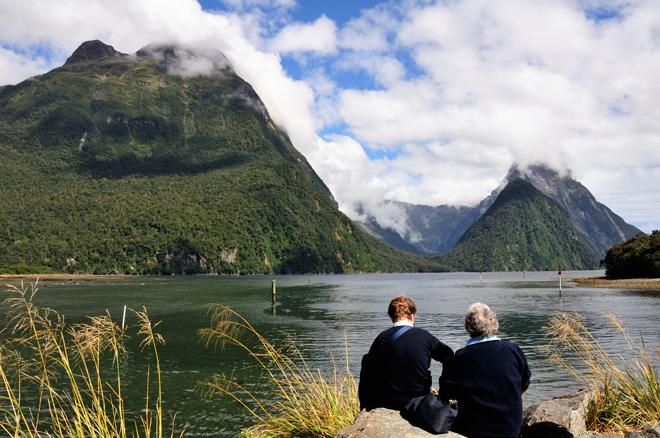
► During a pause on the Milford Sound Red Boat Cruise, I walked to the farthest
edge of a nearby embankment to savor the tranquil fjord. The previous day had brought heavy rain, so
every step across the short 100-meter path was through puddles. I stepped carefully over them, only to
discover another traveler already seated in silence—absorbed in the moment.
This journey to New Zealand offered better accommodations than my 2006 visit, but I noticed a shift: the
fellow travelers were mostly retired expatriates, each enjoying a month-long vacation. My brief two-week
stay felt fleeting in comparison.
When I found the best vantage point already occupied, I retreated to a less prominent position.
Capturing the full fjord view through two people was nearly impossible—so I altered my composition to
include them. Originally, I considered adjusting their proportion in frame, but the surrounding puddles
limited my options. Still, placing human figures within a vast natural scene creates contrast: it
enhances spatial perception and invites deeper reflection. I call this approach “using people to reveal
the landscape.”Nikon D300 & AF-S VR Zoom-Nikkor 18-200mm f/3.5-5.6 G ED
DX
The Final Stroke: The Eye That Brings the Dragon to Life
During the Southern and Northern Dynasties, Zhang Sengyou—right general under Emperor Wu of Liang—was a renowned painter. He excelled in depicting living forms. A folk tale recounts that he painted four dragons on the walls of Anle Temple in Jinling, but left their eyes unpainted. People were puzzled: “Why not paint the eyes?” Zhang replied, “The form is mere shape. The eye holds spirit; if I paint it, the dragon will fly away.”
Others doubted him. He painted eyes on two dragons—and indeed, thunder roared and rain poured as the creatures burst through clouds and ascended. Though mythical, this tale gave rise to the idiom “painting the dragon’s eye” (画龙点睛)—a metaphor for how a single decisive element can bring life to an otherwise static composition. In photography, the focal point is such a stroke: it transforms form into spirit.

◄ On the drive to Franz Josef Glacier, I paused briefly at Lake Hawea to admire its beauty. This is a classic example of human-landscape integration—what I call “using the landscape to enhance the figure.” It evokes a sense of travel, of having been here. While some portraits use wide apertures and shallow depth of field to isolate the subject, this method reverses that logic. When photographing people within a landscape, I begin by considering depth of field and focal point—prioritizing them over other compositional choices. To emphasize the mountain-lake backdrop, I set my aperture to f/16. Shooting at midday under direct overhead light, I used the camera’s built-in flash to fill in shadows and ensure proper exposure of the subject’s face. Though top-lighting is typically unflattering, here it complements the natural beauty of lake and mountain—creating a harmony between light and subject.Nikon D300 & AF-S VR Zoom-Nikkor 18-200mm f/3.5-5.6 G ED DX
3.1.2 Mastery of Depth of Field
Selecting the focal point is not a simple act—it must be paired with deliberate control over depth of field. As discussed in Chapter One, aperture directly influences depth of field. So too do focal length, subject distance, and sensor size.
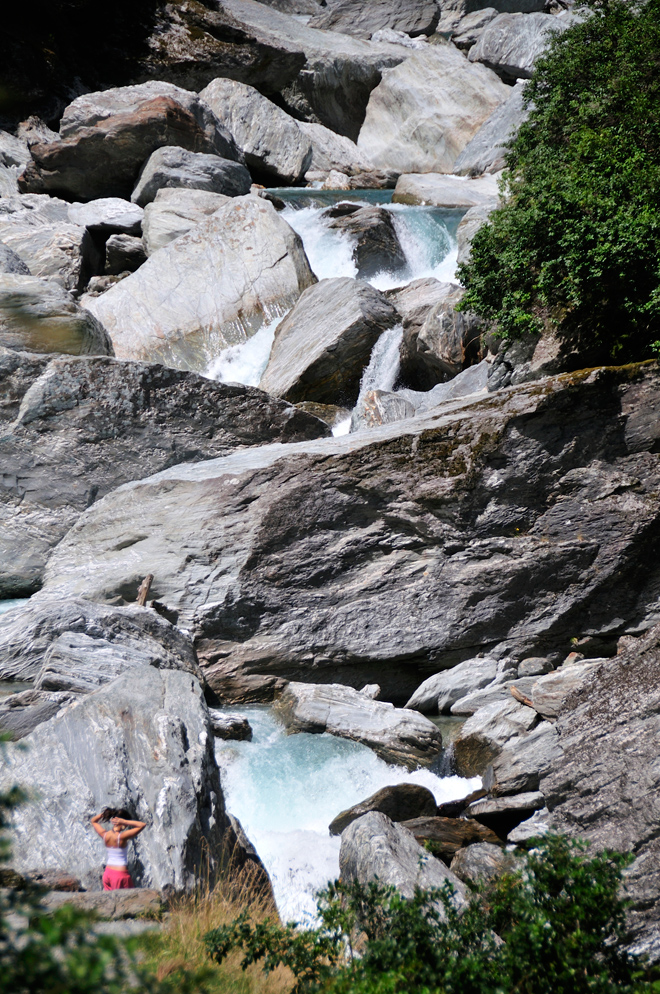
► En route from Wanaka to Franz Josef Glacier, I paused at Haast Pass. At the
Haast River viewpoint, I stepped out to examine glacial terrain shaped by ancient ice—also a brief pause
from long driving.
Though the river once flowed as an ice stream, today only its geological traces remain—turbulent waters
carving dramatic rock formations. I watched others shoot portraits in the rushing current, marveling at
their courage. A couple was moving upstream, searching for a safe spot to wade in.
From my vantage point, the man had already scouted ahead; the woman was preparing to step in. I captured
this moment with a telephoto lens, emphasizing scale: the river’s grandeur becomes evident through human
contrast. In the end, they found no safe place and abandoned their plan.
I used a 135mm focal length (equivalent to 203mm on the D300), aperture f/5.6, shutter speed 1/1600s,
and ISO 1600. The telephoto lens compresses perspective—yet through contrast between subject and
environment, along with visual elements like upper and lower water flow, a sense of depth emerges.Nikon D300 & AF-S VR Zoom-Nikkor 18-200mm f/3.5-5.6 G ED DX
Long vs. Shallow Depth of Field
Mastering depth of field is essential to conveying mood and narrative. It broadly divides into two modes: long and shallow depth of field. Long depth of field ensures clarity from near to far—extending forward and backward from the focal point. This is especially effective in landscape photography.
Shallow depth of field, by contrast, confines sharpness to a narrow plane. This intensifies focus on the subject but demands precision—especially in portraiture, where facial features are three-dimensional. If focus lands on the eyes but depth is too shallow, surrounding contours may blur—creating visual dissonance. Such imbalance undermines the image’s emotional impact.

◄ The shallow depth of field created by a wide aperture not only isolates the
subject but also transforms background elements into dreamy bokeh. During holiday seasons—Christmas or
Lunar New Year—department stores and public spaces often feature festive decorations. These make ideal
backdrops for portraits.
On a visit to see Christmas trees, we encountered a reindeer-drawn sleigh display. I seized the moment:
using spot metering and an aperture of f/2, I kept focus on Zoe’s eyes. The shallow depth rendered the
festive backdrop into a soft blur of colored light—creating an ethereal, seasonal atmosphere. In such
settings, wide apertures evoke a dreamlike quality.Fujifilm FinePix
X100

► Beyond aperture, proximity to the subject and longer focal lengths also reduce depth of field. This close-up of choy sum was shot at f/4—though not a wide aperture, the near distance still produced shallow depth. Despite accurate focus on the subject, background elements—such as the plate’s edge and spoon—appear blurred. When photographing close-ups, aperture must be carefully balanced: too shallow, and the subject blurs; too deep, and unwanted background details emerge. Thus, depth of field control directly shapes the image’s final impact.Fujifilm FinePix X100
Considering the Subject of Focus
Therefore, when composing a photograph, one must consider not only the subject itself but also its depth of field—balancing these elements to authentically convey intention.